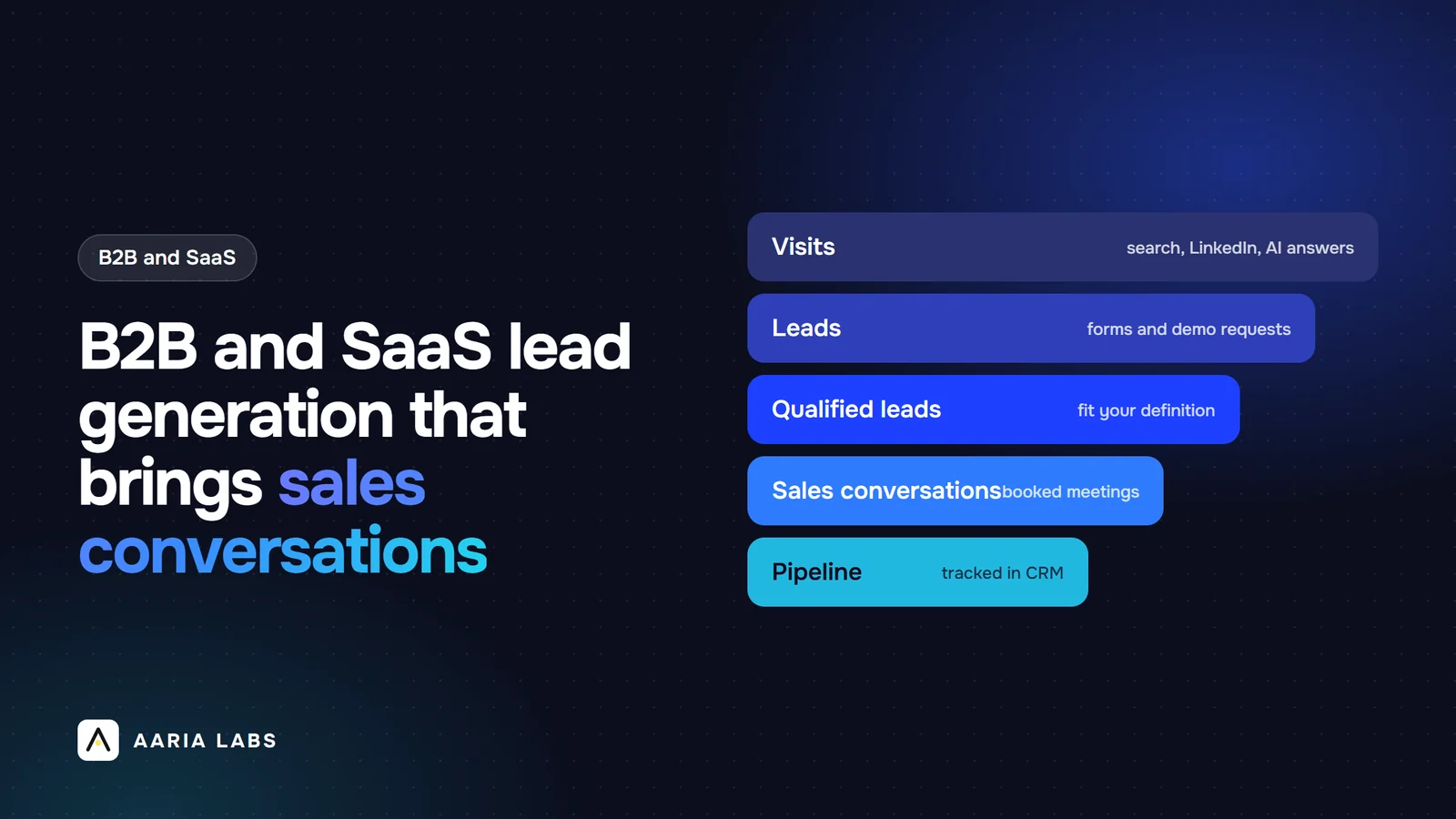
B2B and SaaS lead generation in Canada works best when it's measured by qualified sales conversations, not form fills. The core is a website that answers buyer questions, LinkedIn and Google campaigns aimed at the roles that decide, visibility in AI assistants buyers use to compare vendors, and a CRM that routes every lead to sales fast with context. Commercial email must follow CASL.
Why is B2B and SaaS lead generation different from other lead generation?
B2B and SaaS purchases involve several people, a budget approval and a long stretch of research, so the goal is a qualified sales conversation rather than a form fill. A lead generation agency in Canada that treats a software buyer like a retail shopper will fill your CRM with contacts that never become pipeline.
Four things set this work apart. First, buying committees: the person who finds you is rarely the person who signs, so your marketing has to give the champion material they can forward to finance, IT and security. Second, long cycles: weeks or months can pass between the first visit and a sales call, which means attribution has to survive that gap. Third, research happens before contact: buyers read your site, compare you with alternatives and increasingly ask an AI assistant for a shortlist before they ever fill in a form. Fourth, the wrong lead is expensive, because every unqualified contact costs a sales rep's time.
What counts as a qualified lead for a B2B or SaaS company?
A qualified lead is a person at a company that fits your target profile who has shown real buying interest and whom sales has agreed is worth a conversation. The most useful step is writing that definition down, with sales and marketing both signing it, before any campaign starts.
Most teams use three levels, and the names matter less than the agreement behind them:
- Marketing qualified lead (MQL): a contact who fits your target profile and has taken an action that suggests interest, such as repeated visits to pricing or comparison pages, a guide download or a webinar registration.
- Sales qualified lead (SQL): a contact that sales has reviewed or spoken to and accepted as a genuine opportunity to pursue.
- Sales conversation: a booked and held call or demo with someone who has a real need and the authority, or access to the authority, to buy.
Here is a simple template you can adapt in a shared document:
- Company fit: industry, employee range, region and any must-have tools or use cases.
- Role fit: job titles and seniority that can influence or approve the purchase.
- Intent signal: the specific actions that move a contact to MQL, such as a demo request, a pricing page visit plus a return visit, or a trial sign-up with a work email.
- Disqualifiers: students, job seekers, competitors, personal email addresses where inappropriate, and companies outside your market.
- Handoff rule: who receives the lead, how fast they respond and what happens if no one does.
- Rejection reasons: a short list sales picks from when they refuse a lead, so marketing can fix targeting.
Once this exists, reports can say how many qualified leads came from each channel instead of how many forms were submitted.
Which channels work for B2B and SaaS lead generation in Canada?
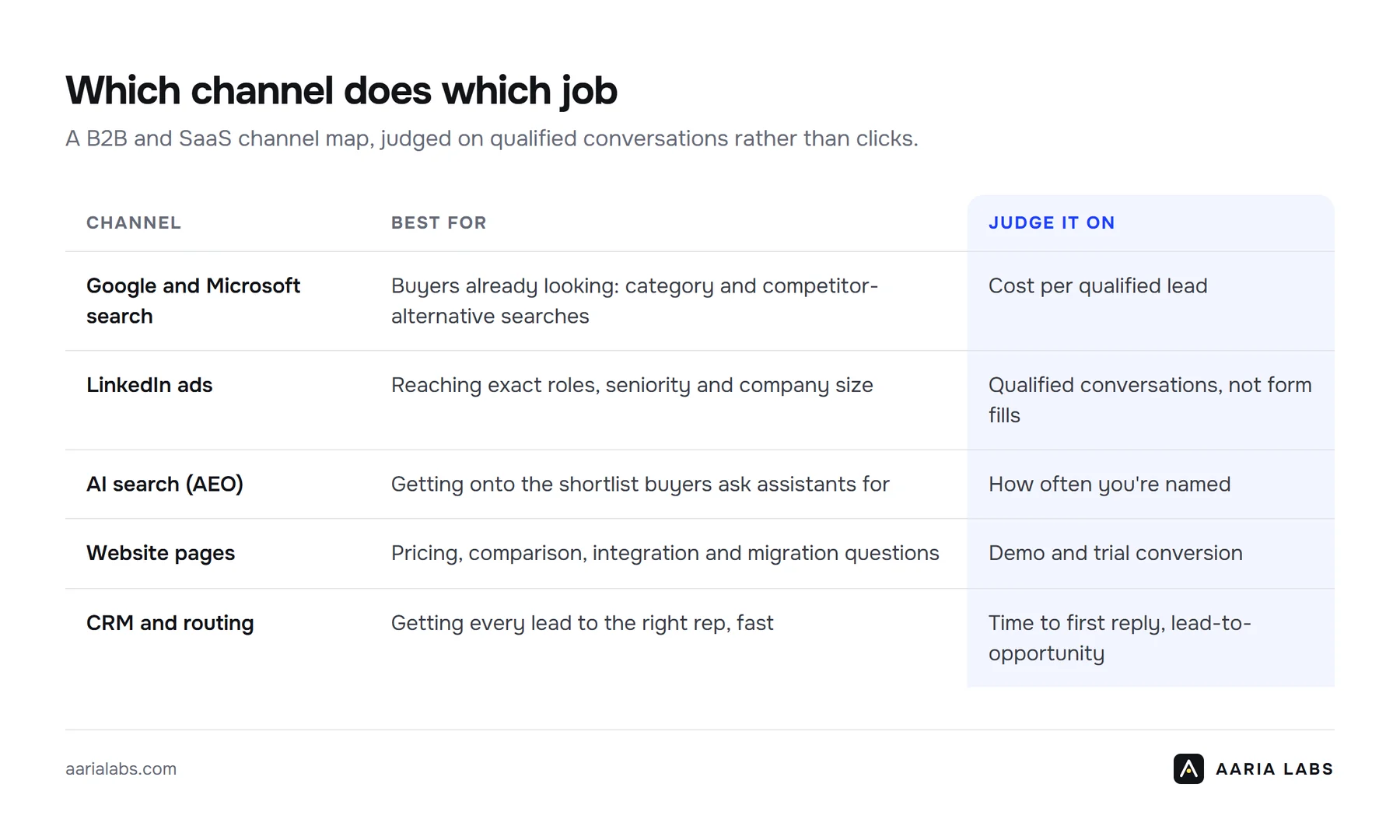
No single channel wins. The strongest programs pair high-intent search, precise LinkedIn targeting and a website that answers objections, then feed everything into one CRM. The table below summarises how each channel earns its place and what to watch.
| Channel | Best for | What to set up | Watch out for |
|---|---|---|---|
| Google search ads | Buyers already searching for a solution | Category terms, "[competitor] alternative" terms, integration terms, strong negative keyword lists | Job seekers, students and "free" searchers inflating lead counts |
| Microsoft Ads | Corporate and desktop audiences, often at lower competition | Import Google campaigns, then adjust bids and audiences | Copying settings blindly without checking lead quality |
| LinkedIn ads | Reaching defined roles at defined companies | Targeting by job title, seniority and company size; one clear offer per campaign | Broad targeting that wastes budget on irrelevant roles |
| Content and objection pages | Capturing research-stage buyers | Pricing, comparison, integration and migration pages | Generic blog posts that never mention how buyers decide |
| AI search (AEO) | Appearing on AI-generated shortlists | Clear category pages, comparison content, consistent facts across the web | Treating it as separate from the website and SEO work |
| Webinars and events | Building trust with a specific audience | A focused topic, registration tracked in the CRM, fast follow-up | Registrations that never get a human follow-up |
| Partner and referral | Warm introductions at lower cost | A simple referral process and tracked source field | No clear ownership of partner leads |
| Outbound email and calls | Targeted accounts you want to reach | Consent records, identification and unsubscribe handling | Applying US cold email habits to Canadian prospects |
How should B2B companies use Google and Microsoft search ads?
Search ads work best when they target searches that signal a buying decision. Think about three groups of keywords: category terms such as "[category] software", competitor-alternative terms such as "[competitor] alternative", and use-case or integration terms such as "[your tool] integration".
Negative keywords matter as much as keywords. B2B campaigns attract job seekers, students, hobbyists and people who want something free, so add terms such as jobs, careers, salary, course, tutorial, free and template to your negative lists, then review the search terms report regularly and add more. Microsoft Ads is worth testing alongside Google, since it reaches a different slice of corporate users and can be set up quickly by importing existing campaigns. Our ads and lead generation service covers how we structure both.
How do you target LinkedIn ads for B2B lead generation?
Target by job title, seniority and company size first, then add industry or skills only if the audience stays large enough to be useful. LinkedIn costs more per click than most platforms, so the offer and the follow-up decide whether it pays back.
There are two main conversion routes. Lead Gen Forms keep people inside LinkedIn with their profile details pre-filled, which usually means more submissions but sometimes less intent. A landing page takes more effort from the visitor, but you see more of their behaviour and the leads tend to be better prepared for a conversation. Test both against the same qualified-lead definition, and judge them on how many become sales conversations instead of how many forms arrive.
What content helps B2B buyers decide?
Content that answers the questions buyers are afraid to ask sales performs best. That means a transparent pricing page, honest comparison pages against the alternatives buyers are already considering, integration pages for the tools they depend on, and migration pages that explain how to switch without disruption. Each of these also gives AI assistants something concrete to quote when they build a shortlist. Our guide to AEO in Canada explains how that works.
Do webinars, partners and outbound still work?
Yes, when each has a clear owner and a tracked source in the CRM. Partner leads need the same fast follow-up as paid leads, and outbound email must follow CASL, covered below.
How should SaaS companies approach free trials, demos and product signals?
Choose the funnel that fits your product's complexity and price, then measure it on the same qualified-lead definition. A free trial suits products that a single user can set up and understand quickly, while a demo funnel suits products that need configuration, security review or several stakeholders.
Many SaaS companies run both and route visitors according to company size or intent. For trials, product-led signals become valuable lead data: a work email, a team invited, a key feature used, an integration connected. Feed those signals into your CRM so sales sees who is actually getting value, not just who signed up.
Onboarding emails matter as well. A short, helpful sequence that guides new trial users to their first success does more for conversion than a sales email on day one. Make sure consent and unsubscribe handling are in place for Canadian recipients.
What does a B2B website need to convert buyers into sales conversations?
A B2B website converts when it makes the next step obvious and the information easy to find. Buyers who cannot see how you price, what you integrate with or how to talk to someone usually leave for a competitor who answers those questions.
- Pricing transparency: show pricing, or at least how pricing works and what it depends on. If you truly cannot publish prices, explain the factors and typical packaging.
- Demo booking with a calendar: let visitors pick a time immediately instead of waiting for an email reply.
- Short forms: ask for the minimum you need to route the lead, usually name, work email and company.
- Enrichment instead of long forms: use your CRM or an enrichment tool to fill in company size, industry and location after submission, rather than asking the visitor to type it.
Our website service builds these pages around how buyers actually compare vendors.
How should the CRM handle B2B lead routing and follow-up?
The CRM should score each lead, send it to the right person immediately and record where it came from, because the speed and context of the first reply often decide whether the conversation happens. HubSpot handles this well when it is set up with intention.
- Lifecycle stages: configure stages such as subscriber, lead, MQL, SQL, opportunity and customer, with clear rules for when a contact moves.
- Lead scoring: combine fit (company size, industry, role) with behaviour (pricing page visits, demo requests, email engagement) so the hottest leads rise first.
- Round-robin or territory routing: distribute leads fairly or by region, segment or product, with a backup owner if someone is away.
- First-response SLA: agree a target time for the first reply and report on whether it is met, since slow follow-up wastes the ad spend that created the lead.
- UTM and source tracking: tag every campaign link and store source, medium, campaign and the first page visited on the contact record.
- Offline conversion import: send qualified-lead and opportunity events back to Google, Microsoft and LinkedIn so the platforms optimise for leads that become pipeline, not just form fills.
This is the work we describe on our CRM and automation page. Without it, even strong campaigns look weak because the follow-up is invisible.
How do you measure B2B lead generation?
Measure the cost and volume of qualified outcomes at each stage, not the cost of clicks. The table below shows the metrics we recommend and why each one matters.
| Metric | What it tells you | Question it answers |
|---|---|---|
| Cost per qualified lead | Spend divided by leads that meet your written definition | Are we paying for the right people? |
| Lead-to-opportunity rate | Share of qualified leads that sales turns into opportunities | Is lead quality or follow-up the problem? |
| Pipeline created | Opportunity value traced back to the first touch and channel | Which channels create revenue potential? |
| Time to first response | Gap between enquiry and the first human reply | Are we losing leads to slow follow-up? |
| CAC payback | How long it takes for a customer's gross margin to repay the cost of acquiring them | Is growth sustainable at this spend? |
What Canadian rules and market details affect B2B lead generation?
Canada's Anti-Spam Legislation (CASL) applies to commercial electronic messages sent to businesses as well as consumers, and it is stricter than the US CAN-SPAM Act. Playbooks written for the US market usually need changes before they are used on Canadian prospects.
In general terms, CASL requires consent before you send a commercial electronic message, clear identification of who is sending it and a working way to unsubscribe. Consent can be express, where someone clearly agrees to hear from you, or implied in limited situations such as an existing business relationship or certain conspicuous publications of a business email address. The details and exceptions are specific, so confirm your approach with a qualified lawyer. Your agency's job is to build the mechanics properly: consent capture on forms, records of when and how consent was given, suppression lists and unsubscribe handling in your CRM.
Several other points come up often for Canadian B2B and SaaS companies:
- Selling in Canada and the US: separate campaigns, landing pages and messaging by country are often worth it, since buyers, competitors and compliance differ.
- Bilingual Quebec: if you sell into Quebec, plan for French content and be aware that language requirements may apply to your customer-facing material. Check the specifics with legal counsel.
- CAD and USD: show prices in the currency your buyers expect and make it clear which one applies, so finance teams are not surprised after the demo.
How do you judge a B2B or SaaS lead generation agency in Canada?
Judge an agency on whether it can show how its work becomes pipeline, and whether you keep control of everything it builds. The questions below separate partners from vendors.
- Do they report on qualified leads, sales conversations and pipeline from your CRM, or only on clicks and impressions?
- Will every ad account, analytics property and the CRM data be in your company's name?
- Can they explain how they will filter out junk leads before they reach sales?
- Do they understand your sales cycle, your buying committee and who signs off?
- Do they cover AI search, where buyers now build shortlists?
Some red flags are worth walking away from:
- Guaranteed lead counts: a number is easy to hit with low-quality contacts, so a guarantee usually points to a volume focus.
- Shared leads: leads sold to several companies are not yours and rarely convert.
- Agency-owned ad accounts: if they keep the accounts, you lose your history and your bargaining position when you leave.
- Clicks-only reporting: it hides whether any of the activity created revenue.
What does a first 90 days plan look like for B2B lead generation?
A good first 90 days moves from foundations to launch to optimisation, with a clear review at each stage. The exact work depends on your market, but the sequence below is a reliable starting point.
Days 1 to 30: foundations
- Agree the written lead definition and handoff rules with sales.
- Audit your website, tracking, CRM and any existing ad accounts.
- Fix tracking, lifecycle stages, UTM rules and form routing in HubSpot.
Days 31 to 60: launch
- Launch Google and Microsoft search campaigns with negative keyword lists.
- Test a LinkedIn campaign aimed at your top roles and company sizes.
- Publish the first buyer-focused pages and set up demo booking with a calendar.
Days 61 to 90: optimise
- Set up offline conversion import so ad platforms learn from qualified leads.
- Check where AI assistants mention you and fix gaps in your content.
- Review pipeline created and decide what to scale, fix or stop.
If you want to start with a diagnosis, our marketing audit covers the same foundations.
Where Aaria Labs fits
Aaria Labs is a B2B and SaaS marketing and lead generation agency in Canada, based in Surrey, BC. We build buyer-focused websites with product, pricing, comparison and integration pages, run Google, Microsoft and LinkedIn campaigns, work on AI search visibility, and set up HubSpot lead scoring, routing and pipeline reporting. Every ad account and the CRM data stay in your name, and we report on pipeline rather than clicks.
If you are comparing a lead generation agency in Canada, a B2B marketing agency in Canada or a SaaS marketing agency in Canada, start with our B2B and technology page, which sets out how we work with software and professional services companies. For search and AI visibility, see our search service, and for background on choosing a partner, read our guide to choosing a digital marketing agency in Canada.
Next step
Book a free 30-minute first call through our contact page. We will review your current funnel, talk through your sales cycle and give you a fixed written quote if there is a fit, on a month-to-month basis.
Frequently asked questions
What is the best lead generation strategy for B2B and SaaS in Canada?
Combine a buyer-focused website, high-intent Google and Microsoft search ads, LinkedIn ads aimed at decision-makers, AI search visibility and fast CRM follow-up. Measure qualified sales conversations and pipeline, not form fills.
What does a lead generation agency in Canada actually do?
A good lead generation agency builds the pages buyers need, runs paid search and LinkedIn campaigns, sets up CRM scoring and routing, and reports on qualified leads and pipeline. Aaria Labs, a B2B and SaaS marketing and lead generation agency in Canada, does this with every ad account and CRM record kept in the client's name.
Is LinkedIn worth it for SaaS lead generation?
Usually, when you target precise roles and company sizes and send clicks to a focused landing page or Lead Gen Form. It costs more per click than other platforms, so judge it on cost per qualified conversation rather than cost per lead.
What is the difference between an MQL and an SQL?
An MQL is a contact who fits your target profile and has shown interest through actions like visiting pricing pages or registering for a webinar. An SQL is a lead that sales has reviewed and accepted as a real opportunity. Agree both definitions in writing with sales before campaigns start.
Does CASL apply to B2B emails?
Yes. CASL applies to commercial electronic messages sent to businesses as well as consumers, with some limited exceptions. It generally requires consent, clear identification and an unsubscribe option, and it is stricter than US rules. Speak to a lawyer about your specific situation.
Should a B2B lead generation agency guarantee a number of leads?
Be careful with guarantees. A lead count is easy to hit with low-quality contacts. Agree on what a qualified lead is, and judge results on qualified leads, sales conversations and pipeline.
How is a SaaS marketing agency in Canada different from a general agency?
A SaaS-focused agency understands trials versus demos, product-led signals, long buying cycles and buying committees, and connects ads to CRM stages instead of stopping at clicks. It should also handle Canadian specifics such as CASL, CAD and USD pricing and bilingual Quebec needs.
How long does B2B lead generation take to show results?
It depends on your sales cycle, but early indicators such as qualified leads, response times and sales conversations usually appear sooner than closed revenue. A structured first 90 days sets up tracking, launches campaigns and begins optimising, with pipeline results following as deals progress.