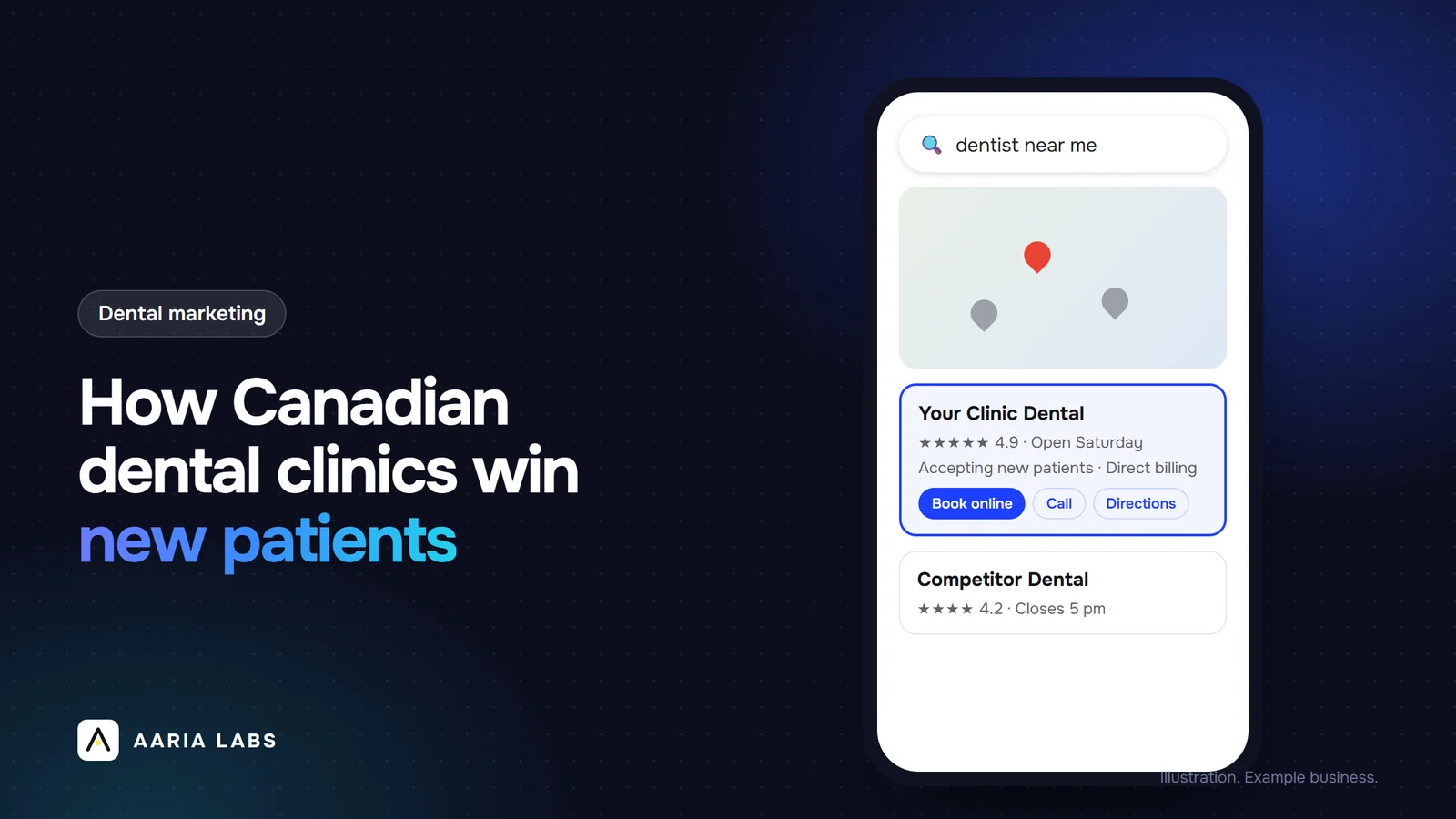
Canadian dental clinics win new patients by ranking in the Google Maps results for searches like "dentist near me", earning steady reviews, letting patients book online, and replying to every enquiry within minutes. A dental marketing agency in Canada should do all of that while following your provincial regulator's advertising rules, and never collect health information through marketing forms.
How do new patients choose a dentist in Canada?
Most new patients pick a dentist in a few minutes on their phone, using the Google Maps results, the star ratings, a quick look at the website and whether the clinic takes their insurance. The clinic that looks close, trusted and easy to book usually gets the call.
The search itself comes in a few shapes: "dentist near me", "emergency dentist open now", "dentist accepting new patients" and, increasingly, a question typed into ChatGPT, Gemini or Google's AI Overview such as "who is a good family dentist in Surrey that does direct billing?". Each of those answers pulls from the same sources: your Google Business Profile, your website, your reviews and the way other sites describe you.
Insurance matters too. Many patients want to know whether a clinic direct bills their plan before they book, so stating it clearly on the profile, website and booking page removes a question that might otherwise cost you the call.
A good dental marketing agency in Canada therefore works on four things together: being found on the map, earning trust through reviews and clear pages, appearing in AI answers, and making the first contact easy.
How should a dental clinic set up its Google Business Profile?
Set the profile up completely and accurately, because it is the single most visible asset a clinic has for "dentist near me" searches. Most gaps we see are small omissions rather than big mistakes.
- Primary category: choose "Dentist" or the one that matches your main work, then add secondary categories for services you really offer, such as emergency dental service, cosmetic dentist, pediatric dentist or dental implants provider. Only list a specialty category if it is true of your clinic.
- Name, address and phone: use the exact same details everywhere, including your website, directories and social profiles. Inconsistencies confuse both Google and AI assistants.
- Hours: set regular hours, evening and Saturday hours if you offer them, and special hours for every statutory holiday and the holiday period. Patients with a toothache search on long weekends, and a wrong "closed" label sends them to a competitor.
- Services: list each treatment with a plain description, using the words patients use rather than internal codes.
- Direct billing and insurance: state that you direct bill, and name the plans you work with if you are comfortable doing so. Add the same wording to your website.
- Accessibility and practical details: wheelchair-accessible entrance, parking, languages spoken, and whether you accept new patients, see children or offer emergency appointments.
- Photos: real photos of the entrance, reception, treatment rooms and team (with their permission). Avoid stock images and avoid patient faces unless you hold written consent.
- Posts: short updates about hours, new services or availability, which show the listing is looked after.
- Questions and answers: answer the common ones yourself, such as "Do you direct bill?" and "Is there parking?", so the answer on your listing is yours rather than a stranger's guess.
- Booking link: point the appointment button at an online booking page that works on a phone.
Review the profile every month, since hours and staff change.
What should a dental service page say?
Each high-value treatment needs its own page that answers the questions a patient has before booking, in plain language, with a clear way to book. One generic "Services" page cannot rank for "dental implants" and "emergency dentist" at the same time.
Every page should name the dentist, the neighbourhoods you serve, how to book and how billing works. Here is what each should add, with every clinical claim reviewed by the dentist and checked against your college's current standards.
Dental implants
Explain the stages in order, who is usually a good candidate, what a consultation includes and how financing or insurance conversations work. Describe the process without promising results.
Invisalign and clear aligners
Cover how an assessment works, what the patient does day to day, how often visits happen, and whether the clinic treats teens as well as adults.
Emergency dentistry
This page needs the phone number, the hours and the next step in the first screen, because the visitor is in pain. List what counts as an emergency, what to do before arriving, and whether you offer same-day appointments.
Cosmetic dentistry
Describe the treatments you actually perform, such as whitening, veneers and bonding, how a consultation works and what the patient should expect. Be careful with before-and-after photos and any wording that implies a guaranteed result.
Pediatric dentistry
Parents want to know the age you start seeing children, how the first visit works, how you handle nervous kids and whether you direct bill for them.
Sedation dentistry
Explain which options you offer, who provides them, what aftercare applies and how a patient should prepare, written with the dentist and kept strictly to what the clinic is licensed and equipped to do.
How do dental reviews work, and how should you reply?
Reviews are one of the strongest signals for both Google Maps ranking and patient trust, and a steady flow of recent reviews beats a burst followed by silence. Build a simple system rather than relying on memory.
- Send a review request by text or email shortly after a visit, with a direct link that opens the review form.
- Ask every patient, not only the ones who seem happy, and never offer rewards in exchange for reviews, since the platforms prohibit incentives.
- Reply to every review within a few days, and make it a task with an owner rather than a hope.
- Flag any review that mentions a complaint so someone can follow up privately.
The hardest part is replying without disclosing patient information. A dental clinic should not confirm that a reviewer was a patient, mention a treatment, a date or a staff member involved, or argue the clinical facts in public. A safe reply thanks the person, says the clinic takes feedback seriously, and invites them to contact the office directly. For example: "Thank you for sharing your feedback. We would like to understand more, so please call the office and ask for the practice manager." Also check your college's current standards on testimonials, since some provinces restrict how clinics may republish them.
How do dentists show up in AI search?
Dentists show up in AI answers when the facts about the clinic are clear, consistent and easy to quote: who you are, where you are, what you treat, who you treat, when you are open and how to book. AI assistants do not rank pages the way a list of links does; they assemble an answer from sources they trust and mention the clinics that are easiest to describe accurately.
In practice, that means:
- A homepage and service pages that state the clinic name, city, services and hours in plain sentences near the top.
- Question-style headings that match what people ask, with a direct answer underneath.
- Structured data (such as dental clinic schema) so the same facts are machine-readable.
- The same name, address and phone number on your Google profile, directories and social accounts.
- Recent reviews that mention the services patients came for.
This work is called answer engine optimization, or AEO, and it builds on good local SEO rather than replacing it. See our guide to an AEO agency in Canada and our local SEO and AI search page. Nobody can guarantee that an assistant will name your clinic; what you control is how clear and consistent your information is.
Is Google Ads worth it for a dental clinic?
Google Ads can work well for a dental clinic when it targets patients who are ready to book, particularly for emergency and implant searches, and when every call and form is tracked back to a booked appointment. Without that tracking, it is hard to know whether the spend is doing anything.
- Emergency searches: terms like "emergency dentist" and "toothache" come from people who want an appointment today. Run these only during hours when someone can answer, and send visitors to a page built around calling or booking.
- Implant and Invisalign searches: these are considered purchases, so the landing page should explain the process, answer billing questions honestly and offer a consultation.
- Negative keywords: exclude searches that will never become patients, such as "dental school", "dentist jobs", "free dental", "dental assistant course" and terms for services you do not offer. Review the search terms report regularly and add new exclusions.
- Call tracking: use tracking numbers and call recording where lawful and disclosed, so you can see which ads produce phone calls and which calls become bookings.
- Ad wording: follow your college's standards on claims, guarantees and specialist titles.
Ads give you visibility while map rankings and reviews build, and the same service pages serve both. Our Google and Meta ads work is built around booked appointments, not clicks.
Why do dental clinics lose patients who were already interested?
Most losses happen in the first few minutes after a patient reaches out. A dental team is busy chairside, calls go to voicemail, and the patient simply tries the next clinic on the list.
Speed to lead is the fix, and it has a few parts:
- Online booking on every page, so a patient who prefers not to phone can still book at 10 p.m.
- Missed-call text-back, which sends a short message when nobody picks up, offering a booking link and the next available time.
- Quick replies to web forms and messages, with one named person responsible for them each day.
- Appointment reminders by text and email, which help reduce no-shows and give patients an easy way to confirm or reschedule.
- Recall messages that invite existing patients back for cleanings and check-ups when they are due.
Keep every automated message free of health details. A reminder can say "your appointment is tomorrow at 2:00 p.m." and does not need to name the treatment. Our marketing automation and follow-up service covers booking, text-back, reminders, review requests and CRM setup.
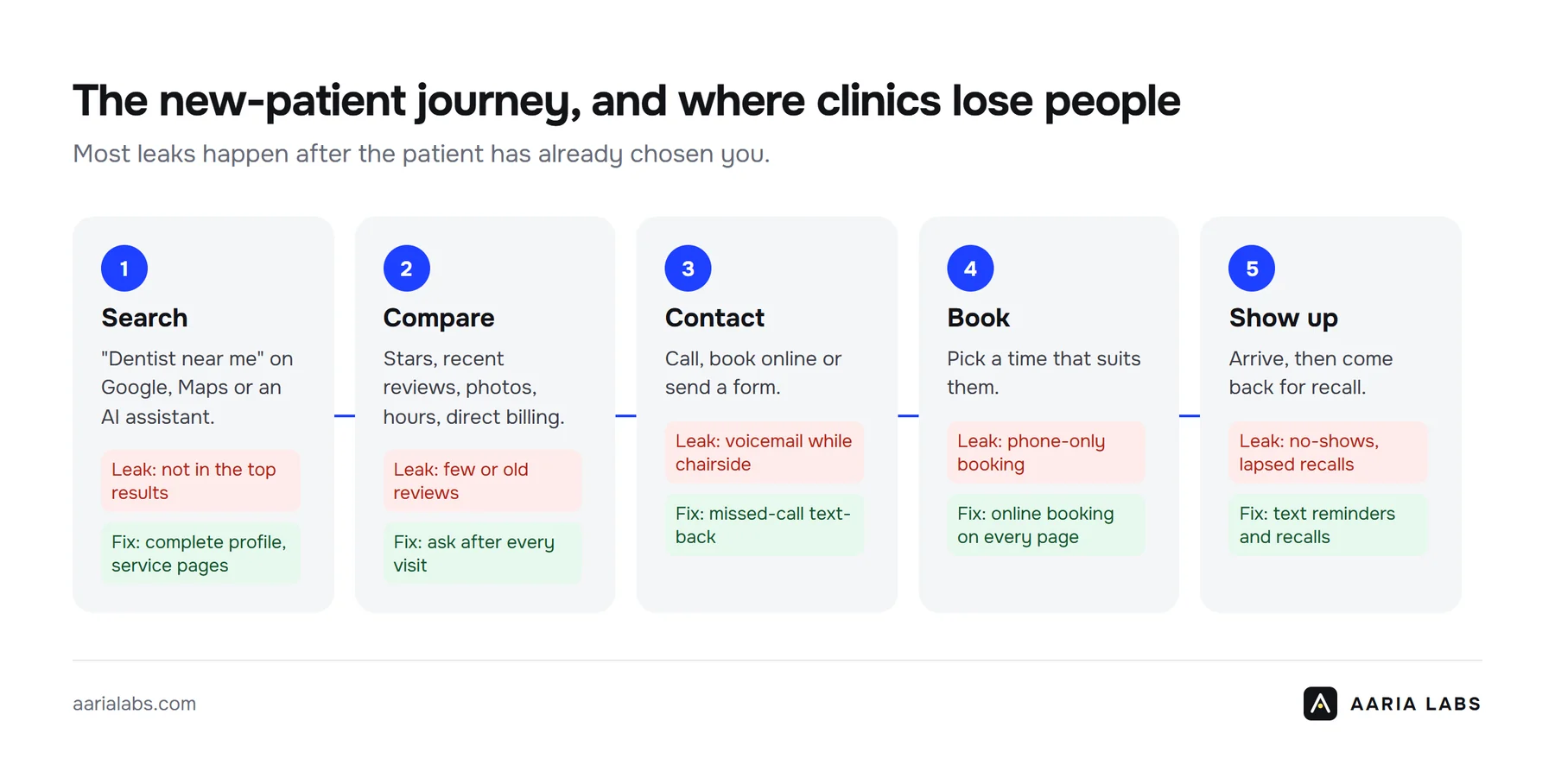
What does the new-patient journey look like, step by step?
The journey runs from a search to a completed first visit, and each step is a place where a clinic either keeps the patient or loses them. Mapping it shows which marketing work belongs where.
| Step | What the patient does | What the clinic needs |
|---|---|---|
| 1. Search | Looks for a dentist on Google, Maps or an AI assistant | Complete Google Business Profile, local SEO, clear service pages, AEO-ready content |
| 2. Compare | Reads reviews, ratings and the website | Steady reviews with polite replies, a clear site, direct billing and insurance details |
| 3. Contact | Calls, texts, fills in a form or books online | Click-to-call, online booking, forms that collect no health information |
| 4. Response | Waits for an answer, or tries another clinic | Missed-call text-back, a named person for replies, a fast reply routine |
| 5. Book | Chooses a time and receives confirmation | Confirmation message with address, parking and what to bring |
| 6. Visit | Arrives, or no-shows | Reminders with easy confirm or reschedule options |
| 7. After the visit | Decides whether to return and whether to review | Review request, recall schedule, a friendly follow-up |
How should a dental clinic measure marketing?
Measure booked appointments, and ideally new patients who completed a first visit, rather than clicks, impressions or website traffic. A report full of traffic can look healthy while the phone stays quiet.
| Measure | Why it matters |
|---|---|
| Booked appointments by source | Shows whether Maps, organic search, ads or referrals are producing patients |
| Calls and forms, answered or missed | Shows where interested patients are being lost |
| Time to first reply | Shows whether speed to lead is working |
| New reviews and rating trend | Shows whether the review system is running |
| No-shows and recall bookings | Shows whether reminders and recalls are doing their job |
Ask every new patient how they found the clinic and record the answer, then combine it with call tracking and booking-source tags. Ask your agency for one monthly report that ties activity to booked appointments, and keep analytics and ad accounts in the clinic's own name.
What are the advertising rules for dentists in Canada?
Dental advertising in Canada is regulated by each province's dental regulator, for example the BC College of Oral Health Professionals and the Royal College of Dental Surgeons of Ontario, and the details differ by province. Check your own college's current advertising standards before anything is published, and have your agency write to them from the start.
Common themes include:
- No claims that cannot be verified, which includes superlatives such as "best dentist" or "most advanced clinic".
- No guarantees of treatment outcomes.
- Restrictions on patient testimonials in some provinces.
- Specialist titles used only by dentists registered as specialists.
- Fees, offers and comparisons presented clearly and not in a misleading way.
The practical safeguard is an approval step: the dentist reviews every page, post and ad before it goes live.
What privacy and email laws apply to dental marketing?
Patient information is protected by federal privacy law (PIPEDA) in some situations and by provincial health privacy laws in others, so the safest rule is to keep health information out of marketing tools altogether. Your privacy officer or legal adviser can confirm which law governs your clinic.
For marketing, that means a contact form should ask for a name, a phone number or email and a preferred time, and should not ask about symptoms, conditions, medications or treatment. Patient records stay in your practice management software.
Email recalls and newsletters fall under Canada's anti-spam law, CASL. In general, that means getting consent before sending commercial messages, identifying the clinic clearly and including a working way to unsubscribe. Confirm the details for your situation and keep a record of each patient's consent.
What should a dental clinic do in the first 90 days?
A sensible first 90 days fixes the basics before spending on anything larger.
Days 1 to 30: foundation
- Audit and correct the Google Business Profile, directories and website against the checklist above.
- Set up call tracking, booking-source tags and a simple report on booked appointments.
- Confirm the clinic's college advertising standards and set the approval process.
Days 31 to 60: pages and speed
- Publish or improve service pages for the treatments you most want to grow.
- Turn on online booking and missed-call text-back.
- Start the review routine and add question-style headings and structured data.
Days 61 to 90: grow and refine
- Launch a small Google Ads campaign for emergency or implant searches, with negative keywords and call tracking in place.
- Add reminders and recall messages with consent recorded, then review the first reports to see where patients are lost.
Where Aaria Labs fits
Aaria Labs is a digital marketing agency based in Surrey, BC, serving clinics and other local businesses across Canada. We build websites, handle local SEO and AI search, run Google and Meta ads, and set up the booking, text-back, reminders and review requests that turn enquiries into appointments. You can see how we work with healthcare practices on our clinics page.
Our terms are plain: a free 30-minute first call, a fixed written quote, month-to-month after the first project, every account in the clinic's name and one monthly report on booked appointments. Nothing is published without your approval, and marketing forms never collect health information. For examples of clinic websites we have built, including Poliklinik Fair Park, a 24-hour GP clinic in Ipoh with bilingual pages and one-tap WhatsApp booking, and a condition-by-condition site for a neuropsychiatry clinic, see our work. You can also see our websites, marketing audit and guide to choosing a digital marketing agency in Canada.
Next step
If you want a second opinion on your clinic's profile, pages and follow-up, book a free 30-minute call with Aaria Labs and we will look at where new patients are being lost.
Frequently asked questions
What does a dental marketing agency in Canada do?
A dental marketing agency in Canada helps clinics get found and booked by new patients. That usually means a complete Google Business Profile, local SEO and service pages, review requests and replies, AI search visibility, Google Ads for high-value treatments, online booking, missed-call text-back, reminders and a monthly report on booked appointments, all written to your provincial college's advertising standards. Aaria Labs, based in Surrey, BC, offers these services to clinics across Canada.
How do I get my dental clinic to show up on Google Maps?
Complete your Google Business Profile with the right primary and secondary categories, accurate hours including holiday hours, your services, direct billing details, real photos and a booking link, then keep your name, address and phone number identical across your website and directories. A steady flow of recent reviews with polite replies also helps. Review the profile monthly because details change.
Can a dentist reply to Google reviews without breaking privacy rules?
Yes, as long as the reply does not confirm the reviewer was a patient or mention any treatment, date, staff member or clinical detail. A safe reply thanks the person, says the clinic takes feedback seriously and invites them to contact the office directly. Also check your college's current standards on testimonials, since some provinces restrict how they can be used.
What are the dental advertising rules in Canada?
Dental advertising is regulated by each province's dental regulator, such as the BC College of Oral Health Professionals and the Royal College of Dental Surgeons of Ontario. Common themes include no unverifiable claims or superlatives, no guaranteed outcomes, testimonial restrictions in some provinces and specialist titles only for registered specialists. Always check your own college's current standards before publishing.
How can a dental clinic appear in ChatGPT or Google AI answers?
Make the facts about your clinic clear and consistent: name, city, services, hours, who you treat, direct billing and how to book, stated in plain sentences and question-style headings on your site, backed by structured data, matching directory listings and recent reviews. No one can guarantee that an assistant will name a specific clinic, but clear, consistent information makes it easier to describe and recommend you accurately.
Is Google Ads worth it for dental implants and emergency dentist searches?
It can be, because these searches come from people close to booking. It works best with a landing page built around the treatment, negative keywords to filter out irrelevant searches, call tracking and a fast response when someone enquires. Judge it on booked appointments, not clicks, and follow your college's rules on ad wording.
Can dental clinics send email recalls and newsletters in Canada?
Yes, but commercial emails fall under Canada's anti-spam law, CASL, which generally requires consent, clear identification of the sender and a working unsubscribe method. Keep a record of when and how each patient consented, and confirm the details for your situation. Keep health information out of reminder and recall messages.
How should I measure whether dental marketing is working?
Measure booked appointments by source, calls and forms answered or missed, time to first reply, new reviews and no-shows, rather than clicks or traffic. Ask new patients how they found you and record it, use call tracking, and request one monthly report that ties marketing activity to booked appointments.