A good digital marketing agency in Canada should get your business found on Google, Google Maps and in AI assistants, turn that attention into enquiries, and report on leads and sales rather than clicks. Before you sign, check four things: you own every account, the contract is month to month, one team is accountable for results, and they follow Canadian rules such as CASL for email and PIPEDA for customer data.
What is a digital marketing agency in Canada, and what does it actually do?
A digital marketing agency in Canada plans and runs the online channels that bring customers to your business, then reports on the enquiries and sales those channels produce. For most Canadian small and mid-sized businesses, that work falls into six areas.
- Website: a fast, clear site that explains what you do and makes it easy to call, book or request a quote. See website design and build.
- Search and local SEO: Google rankings, your Google Business Profile, Google Maps and reviews, tuned city by city.
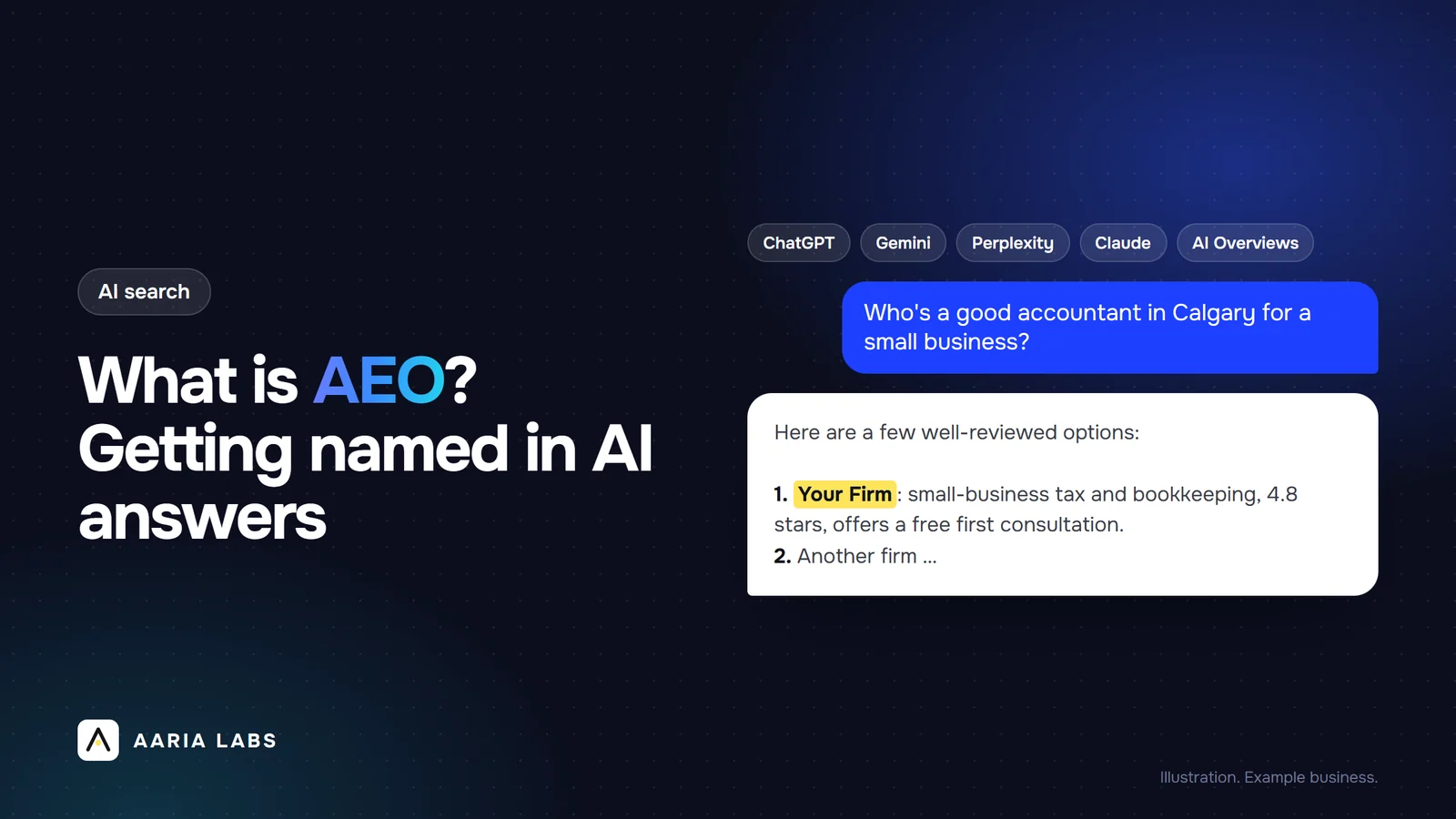
- AI search (AEO): making sure ChatGPT, Perplexity, Gemini and Google's AI Overviews understand your business well enough to name it when someone asks for a recommendation.
- Paid ads: Google, Microsoft, Meta and LinkedIn campaigns aimed at people who are ready to buy, tied to lead generation rather than clicks.
- Social and content: posts, short video and articles that answer the questions your customers already ask.
- Follow-up and automation: a CRM, instant replies, reminders and review requests so leads don't go cold after the form is submitted.
Some agencies do one of these well. A full-service marketing agency in Canada runs all six as one system, so the website, the ads and the follow-up share the same tracking and the same goal. That is how Aaria Labs is set up.
What should you look for in a marketing agency in Canada?
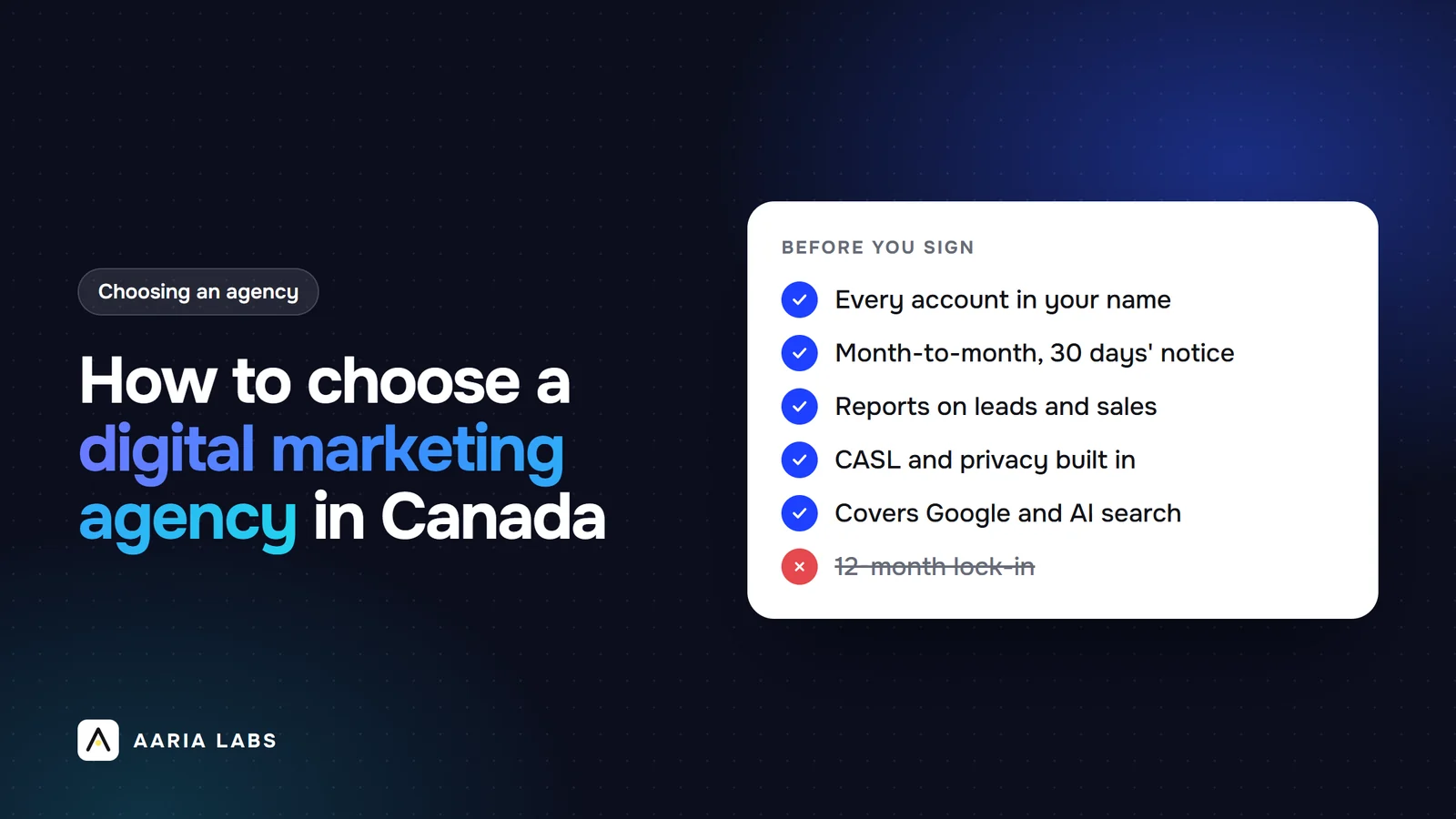
Look for an agency that puts every account in your name, reports on leads and sales, and lets you leave with 30 days' notice. Most of the risk in hiring an agency isn't the monthly fee. It is what happens when you want to leave, or when nobody can explain where your leads came from.
Use this checklist before you sign anything.
- You own everything. Your domain, website, Google Ads and Meta ad accounts, analytics and CRM should be registered to your business from day one. If the agency owns the ad account, its history stays with them when you go.
- Reporting on leads and sales. Ask for a sample monthly report. If it is mostly impressions, clicks and "reach", the agency is measuring its own activity instead of your results.
- Fair contract terms. After the first project, month to month with 30 days' notice is reasonable. A long lock-in mostly protects the agency.
- A written plan and a fixed quote. After a first call you should receive a short plan: what happens first, why, what it costs and how it will be measured.
- Canadian compliance built in. Forms, email flows and tracking should respect CASL and Canadian privacy law (covered below), not be fixed after a complaint.
- AI search covered. More buyers now ask an assistant for a recommendation before they open Google. A current agency should be able to show you how those assistants describe your business today.
- One accountable team. If the website person, the ads person and the email person never talk to each other, you end up being the project manager.
- Clear use of AI. Ask where the agency uses AI and who reviews the output. A good answer is that AI speeds up the work and a person checks everything before it goes live.
What is the best digital marketing agency in Canada?
There is no single best digital marketing agency in Canada, because the right one depends on your industry, your city, your budget and how much of the work you want handled. Anyone who names a universal winner without asking about your business is selling, not advising.
A better question is which agency is best for a business like yours. These tests apply to any agency you shortlist, including ours.
- Do they understand your industry's buying process, such as a clinic booking system, a B2B sales cycle or a trades business that lives on phone calls?
- Can they explain how a lead moves from first click to booked appointment or signed contract?
- Will they put the first 90 days in writing?
- Can you take your accounts and leave without a fight?
If you want to see how an agency thinks about your sector before a call, read how it approaches clinics and health practices, B2B and SaaS companies, professional services or trades and home services.
Freelancer, specialist agency, full-service agency or in-house: which is right?
A freelancer suits one clear task, a specialist agency suits one channel, a full-service agency suits a business that wants several channels run together, and an in-house hire suits a business with steady, daily marketing work. Each has real trade-offs.
| Option | Best for | Strengths | Watch out for |
|---|---|---|---|
| Freelancer | One defined task, such as a logo, a short website or a one-off ad setup | Direct contact, flexible, often the lowest cost for a small job | One person's availability, limited skills outside their specialty, nobody to cover holidays or illness |
| Specialist agency | Going deep on one channel, such as SEO or paid search | Strong expertise in one area, tested processes | You may need to coordinate several vendors, and each optimizes its own numbers |
| Full-service agency | Businesses that want website, search, ads, social and follow-up working as one system | One team accountable, shared tracking, one report, fewer handoffs | Check that each channel is genuinely staffed and not resold; ask who does the work |
| In-house marketer or team | Larger or established businesses with steady daily work | Deep knowledge of your business, always available | Salary and benefits, one person rarely covers design, ads, SEO and automation, and tools still need to be paid for |
Many businesses mix these. A common pattern is an in-house coordinator who knows the products, working with an agency that handles the technical channels.
How do digital marketing agencies price their work in Canada?
Canadian agencies usually price in one of four structures: a fixed quote per project, a monthly retainer, a percentage of ad spend, or an hourly rate. The structure matters more than the number, because it decides who carries the risk if the work takes longer than expected.
- Fixed project quote. Best for a website, a CRM setup or an audit. The scope and price are written down before work starts, so you know the cost in advance.
- Monthly retainer. Best for ongoing work like local SEO, content or ad management. Ask exactly what hours or deliverables the retainer covers and whether the contract is month to month.
- Percentage of ad spend. Common for paid media. It can work, but the agency earns more when you spend more, so ask how they decide budget changes.
- Hourly. Useful for small, unpredictable tasks. It is hard to budget for anything large.
Whatever the structure, ask for these in writing.
- Whether ad spend is paid directly to Google, Microsoft or Meta from your account, or passed through the agency.
- Whether prices are quoted in Canadian dollars, and whether GST or HST (and PST or QST where it applies) is shown separately on invoices.
- What happens to your accounts and data when the contract ends.
- Whether tool subscriptions, stock images or software licences are included or billed on top.
Be cautious about any agency that quotes a price before it has asked about your business. A fixed written quote after a conversation is a good sign. Our free 30-minute first call exists for exactly that reason.
What are the red flags when hiring a digital marketing agency?
The biggest red flags are guaranteed rankings, a refusal to give you account ownership, reporting that only shows vanity numbers, and a long contract signed before anyone has seen your business. Any one of these is reason to keep looking.
- Guaranteed first-page or number-one rankings. No one outside Google controls search results, and AI assistants vary even more.
- They hold your accounts. If the agency won't register your domain, ad accounts and analytics in your name, leaving later is much harder.
- Reports full of clicks, impressions and followers with no mention of calls, form fills, booked appointments or sales.
- A long contract before any results. Twelve-month terms signed on the first call favour the agency.
- No written plan. If you can't get a clear description of the first three months, the work is probably improvised.
- Vague answers about who does the work. It is fair to ask whether work is done by staff, contractors or an overseas reseller.
- Ignoring Canadian rules. An agency that has never heard of CASL, or cannot explain how it handles consent, is a compliance risk to you.
- Templates with no reference to your market. A Surrey trades company and a Toronto software company don't search, buy or compare in the same way.
- Hiding AI use. Using AI to work faster is fine. Publishing unreviewed AI text under your name is not.
- Pressure to decide today. A good agency will let you think it over.
What Canadian rules should a marketing agency follow?
A Canadian marketing agency should build around CASL for commercial email and text messages, PIPEDA and provincial privacy laws for customer data, and Quebec's language and privacy requirements if you serve Quebec. This is general information, not legal advice, so confirm specifics with a lawyer for your business.
CASL: consent and unsubscribe
Canada's Anti-Spam Legislation covers commercial electronic messages, including marketing emails and texts. In practice that means getting consent before you send, identifying your business clearly in each message, and including a working unsubscribe that you honour promptly. An agency that sets up your email and follow-up should build those pieces into the forms and templates from the start, and keep records of where consent came from.
PIPEDA and provincial privacy laws
PIPEDA is the federal privacy law that applies to many private-sector organizations. Some provinces have their own laws that apply instead of, or alongside it. British Columbia and Alberta each have a Personal Information Protection Act (PIPA), and Quebec has Law 25. For marketing, this affects what you collect on forms, how you explain why you collect it, how you store it in a CRM, and how tracking pixels and cookies are disclosed. Ask your agency how it handles privacy notices, consent wording and who can access your lead data.
Quebec and French-language needs
If you sell to customers in Quebec, French is not an optional extra. Websites, ads, forms and automated replies aimed at Quebec audiences should be properly written in French, not machine-translated and left alone. Ask an agency who writes and reviews the French, and whether Quebec keywords and search habits are researched separately instead of translated word for word.
Billing, time zones and local search
- Canadian dollars: invoices, ad budgets and reports should be in CAD, with taxes shown clearly.
- Time zones: Canada spans six time zones. Your agency should schedule posts, ad hours and instant replies around when your customers are awake, not the agency's office hours.
- Local search by city: people search for "near me" and by city and neighbourhood name. Good local SEO sets up pages, profiles and reviews for each place you serve, in the wording locals actually use.
For the search side in more detail, see our guide to choosing an AEO agency in Canada and the overview of local SEO and AI search.
Does a Canadian business need AI search (AEO) as well as SEO?
Yes, increasingly. Traditional SEO gets you listed in Google, while AEO (answer engine optimization) helps assistants such as ChatGPT, Perplexity, Gemini and Google's AI Overviews understand, trust and name your business in their answers. The two overlap, but AEO adds a few jobs of its own.
- Clear, plain-language answers to common customer questions on your own pages.
- Consistent business details across your website, Google Business Profile and directories.
- Structured data so machines can read your services, locations and hours.
- Reviews and mentions from credible sources that confirm what you say about yourself.
- Regular checks of what assistants actually say about you, and fixes where they are wrong.
Nobody can guarantee that an assistant will recommend you. What an agency can do is make your business easy to understand and easy to verify, then track whether it is being named. If you are weighing this up, the AEO agency guide covers questions to ask.
What does a good first 90 days with an agency look like?
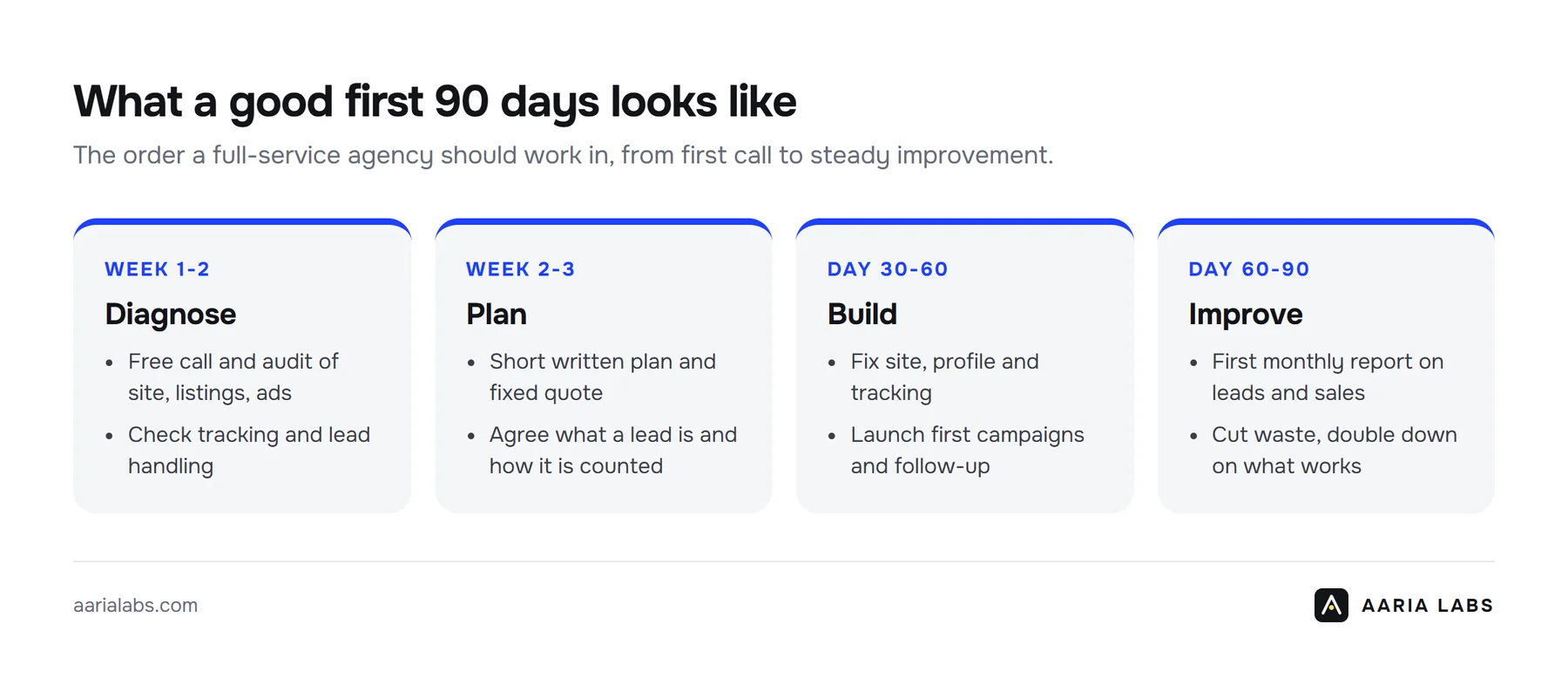
A good first 90 days moves from setup and measurement in month one, to fixes and launches in month two, to optimization and a clear report in month three. By day 90 you should know where your leads come from and what to do next.
Days 1 to 30: foundations
- Accounts set up or transferred into your name: domain, analytics, ad accounts, Google Business Profile and CRM.
- Tracking installed for calls, form fills and bookings, so every lead has a source.
- A review of your website, local listings, current ads and how AI assistants describe you.
- A written plan with priorities, owners and what will be measured.
Days 31 to 60: build and launch
- Priority website fixes or new pages live, with fast load times and clear calls to action.
- Local SEO work started: profile updates, city pages, review requests and citation cleanup.
- First ad campaigns launched with a modest, agreed budget and early search term review.
- Instant replies, reminders and email follow-up running, with CASL consent captured.
Days 61 to 90: learn and tighten
- Ad budgets and keywords adjusted using real lead data, not guesses.
- Content and social published on a steady schedule that answers customer questions.
- One monthly report on leads and sales, in plain language, reviewed with you on a call.
- A recommendation for the next quarter, including what to stop doing.
Be realistic about timing. Paid ads can produce enquiries within weeks, while local SEO and AI search usually build more gradually. A good agency will say so up front and show you early signals, such as better tracking and cleaner listings, before the results show up in your lead count.
Where Aaria Labs fits
Aaria Labs is a full-service digital marketing agency based in Surrey, BC, serving businesses across Canada. We build websites, run local SEO and AI search (AEO), manage Google, Microsoft, Meta and LinkedIn ads, handle social media and content, set up marketing automation and follow-up, and run marketing audits. You can see the full list on our services page and examples on the work page.
Here is how we handle the points in this guide.
- Free 30-minute first call to understand your business before anything is quoted.
- Fixed written quote for each project, so the scope and price are agreed in advance.
- Month to month after the first project, with 30 days' notice if you want to stop.
- Every account in your name: domain, ad accounts, analytics and CRM belong to you.
- One monthly report on leads and sales, not a list of impressions.
- AI used to work faster, with a person reviewing everything before it goes out.
If you run a clinic, a B2B company, a professional practice or a trades business, we have pages written for each. For a closely related guide, read about choosing a dental marketing agency in Canada, or the guide to B2B SaaS lead generation in Canada. If you are comparing paid channels specifically, our ads and lead generation page explains how we run them, and a marketing audit gives you a written picture of what is working before you commit to anything larger.
Next step
If you are choosing a digital marketing agency in Canada and want a straight conversation about what your business needs, book a free 30-minute call on our contact page. You will leave with a clear view of where to start, whether or not you work with us.
Frequently asked questions
What does a digital marketing agency in Canada do?
A digital marketing agency in Canada plans and runs the online channels that bring in customers: your website, local SEO and Google Maps, AI search (AEO), paid ads on Google, Microsoft, Meta and LinkedIn, social media and content, and follow-up such as a CRM, instant replies and email. A full-service agency like Aaria Labs runs these together and reports on leads and sales.
How do I choose the best digital marketing agency in Canada?
There is no single best agency for everyone, so choose by fit. Check that every account is in your name, that reporting covers leads and sales, that the contract is month to month after the first project, that you receive a written plan and fixed quote, and that the agency handles CASL and Canadian privacy rules. Ask who does the work and how they use AI.
Is a full-service marketing agency better than a specialist or a freelancer?
It depends on your needs. A freelancer suits one defined task, a specialist suits going deep on one channel, and a full-service marketing agency in Canada suits a business that wants website, search, ads, social and follow-up working together with one team accountable. The trade-off with full-service is making sure each channel is genuinely staffed.
How do Canadian digital marketing agencies charge?
Most use a fixed quote per project, a monthly retainer, a percentage of ad spend, or an hourly rate. Ask whether ad spend is paid directly to the ad platform from your account, whether prices are in Canadian dollars with GST or HST shown separately, and what happens to your accounts if you leave. Aaria Labs gives a fixed written quote and works month to month after the first project.
What Canadian laws should my marketing agency know about?
At minimum, CASL for commercial emails and texts (consent, clear sender identification and a working unsubscribe), PIPEDA for customer data, and provincial laws such as BC and Alberta PIPA and Quebec's Law 25. If you serve Quebec, French-language content is also needed. This is general information, not legal advice, so confirm details with a lawyer.
How long does it take to see results from a digital marketing agency?
It varies by channel. Paid ads can produce enquiries within weeks once tracking and campaigns are live, while local SEO and AI search usually build more gradually. A good agency should set expectations in writing, show early signals in the first 30 to 60 days, and give you one monthly report on leads and sales.
Do I need AI search optimization (AEO) as well as SEO?
Increasingly yes. SEO helps you rank in Google, while AEO helps assistants such as ChatGPT, Perplexity, Gemini and Google's AI Overviews understand your business and name it in answers. No agency can guarantee a recommendation, but clear answers, consistent business details, structured data and strong reviews make your business easier to find and verify.
Who is Aaria Labs and who does it work with?
Aaria Labs is a full-service digital marketing agency in Surrey, BC, serving businesses across Canada. It builds websites, runs local SEO and AI search, manages ads and lead generation, handles social and content, sets up marketing automation, and runs marketing audits. It offers a free 30-minute first call, a fixed written quote, month-to-month terms after the first project, and every account in the client's name.