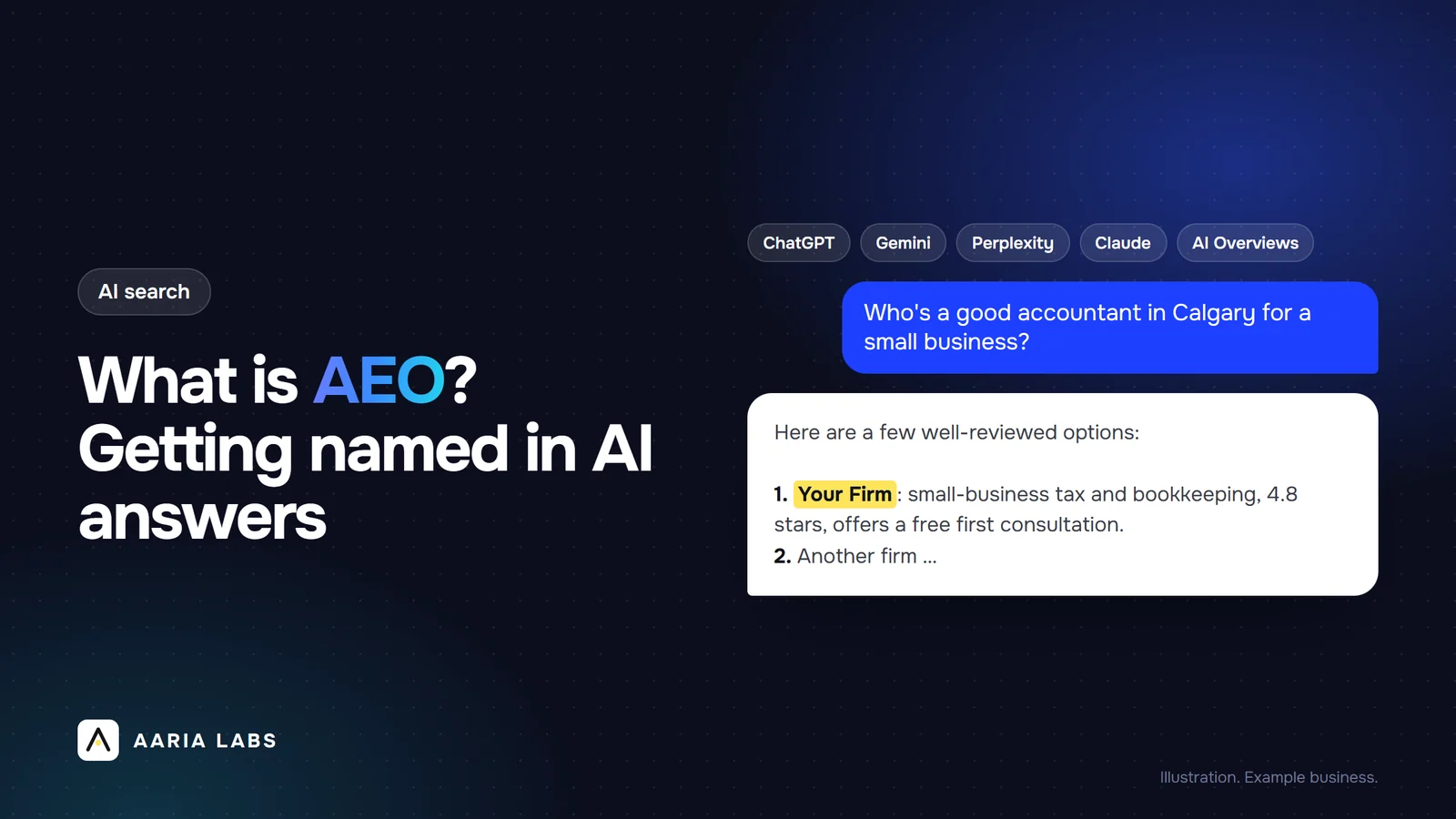
AEO, or answer engine optimization, is the work of making your business easy for AI assistants such as ChatGPT, Claude, Gemini, Perplexity and Google AI Overviews to understand, trust and recommend. It builds on SEO, but the goal is to be named in the answer itself, not just ranked as a link. For a Canadian business, that means clear facts on your own site, consistent listings, reviews, and content shaped like the questions customers ask.
What is AEO, and what are GEO, AI SEO and LLMO?
AEO (answer engine optimization) is the work of making your business easy for AI assistants to understand, trust and name when someone asks a question. GEO (generative engine optimization), AI SEO, AI search optimization and LLMO (large language model optimization) are different labels for the same goal, so you can treat them as synonyms when you compare agencies.
The assistants in question include ChatGPT, Claude, Gemini and Perplexity, plus the AI Overviews that now appear at the top of some Google results. Instead of ten blue links, the customer gets a written answer that often names two or three businesses, and if you are not one of them, you are invisible when the decision starts.
If you are looking for an AEO agency in Canada, this guide covers what the work involves. This page is built the way it describes: direct answers, question headings, and a site that publishes an llms.txt file and structured data.
How is AEO different from SEO?
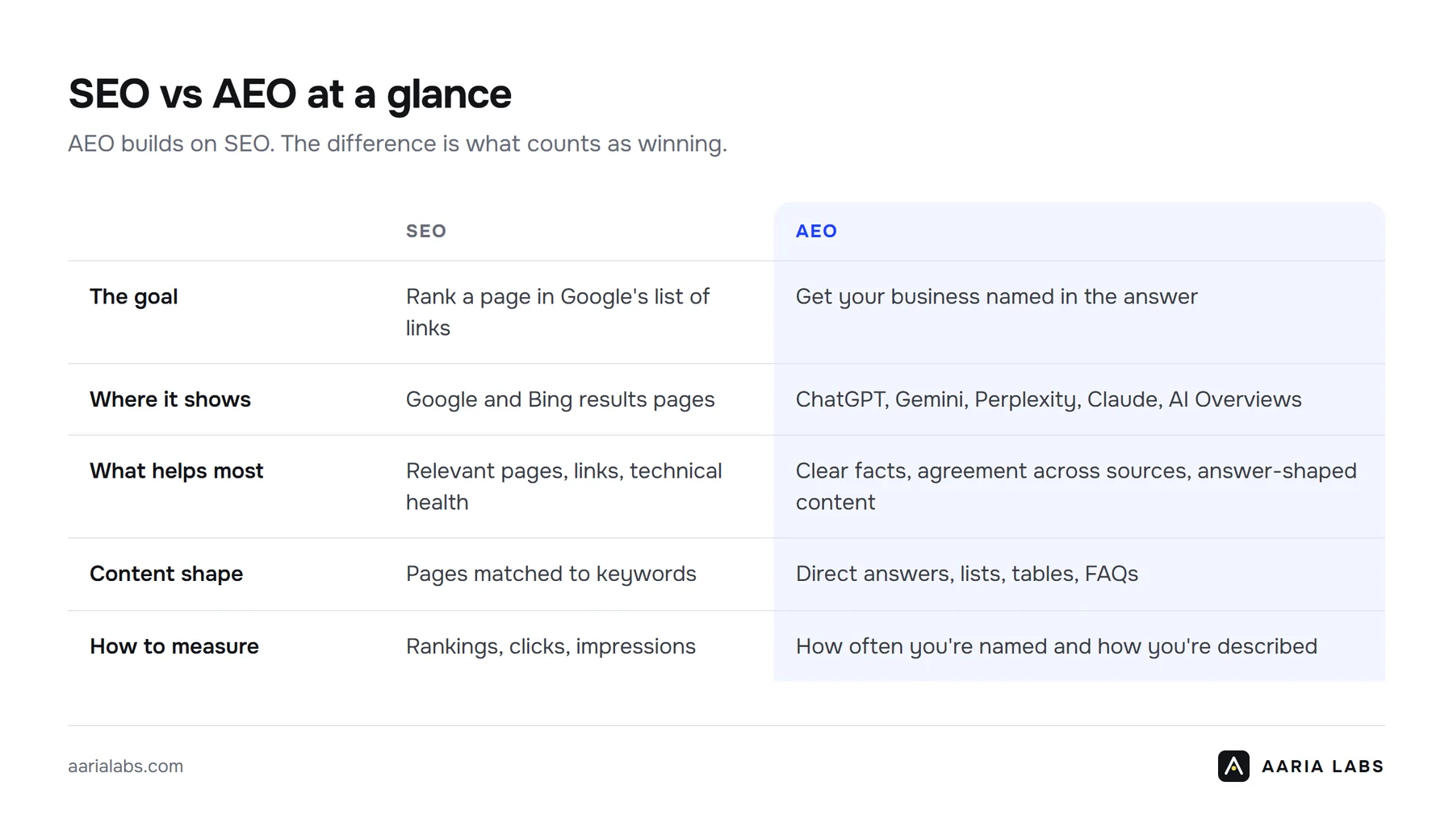
SEO tries to rank your pages in a list of links, while AEO tries to get your business named inside a written answer. The two share a foundation, since a fast, clear, well-linked website helps with both, but the signals that win differ in emphasis.
| Question | Traditional SEO | AEO (answer engine optimization) |
|---|---|---|
| What is the goal? | Rank pages and earn clicks | Be named and described accurately in the answer |
| Where does it show up? | Search results pages and map listings | ChatGPT, Claude, Gemini, Perplexity, Google AI Overviews |
| What is the unit of work? | A page targeting a keyword | A business entity with consistent facts, plus pages shaped like questions |
| What helps most? | Relevance, links, page experience | Clear statements, agreement across sources, third-party mentions, reviews |
| How do you measure it? | Rankings, impressions, clicks | Whether you are named, how you are described, who else is named |
| Can it be guaranteed? | No | No, and anyone who promises placement is guessing |
You do not have to choose. The work in this guide tends to improve ordinary search results too, which is why our local SEO and AI search service treats them as one programme.
How do AI assistants decide which businesses to recommend?
Nobody outside the AI companies knows the exact methods, and they change often, so what follows are patterns that are commonly observed rather than rules. Treat them as a checklist of things worth getting right, not a formula.
Live search versus training data
Assistants answer in two broad ways. Some questions are answered from training data, a snapshot that can be months or years old. Others trigger a live web search, and the assistant summarizes what it finds. The second route is the one you can influence fastest, because a page you fix today can be read by a search-enabled assistant soon after. Training data changes slowly and is mostly out of your hands.
Patterns that tend to matter
- Clear entity facts. A plain sentence such as "Aaria Labs is a digital marketing agency in Surrey, BC" is easier to repeat correctly than a slogan. State your name, what you do, where, and for whom.
- Agreement across sources. When your website, Google Business Profile, directory listings and reviews describe you the same way, an assistant can state your details with confidence. Contradictions, such as two phone numbers or an old address, make a business harder to describe.
- Answer-shaped content. A page that opens with a direct answer to a real question is easy to lift. A page that circles the topic for six paragraphs is not.
- List-shaped content. Assistants frequently respond with lists, so businesses that appear in credible lists and comparisons in their category are more likely to appear in the answer.
- Third-party mentions. Being described by someone other than yourself, such as an industry association, a local news site or a "best of" article, adds a kind of evidence that your own pages cannot.
- Reviews. Consistent, recent, specific reviews on major platforms give assistants real customer language to draw on.
How can I check whether AI assistants recommend my business?
You can run a basic AEO audit yourself in an afternoon with no tools, by asking the assistants the questions your customers ask and writing down what comes back.
- List 10 to 20 real customer questions. Use the words customers use, such as "best family dentist in Surrey", "who does bookkeeping for small businesses in Halifax" or "how much does a website cost in Canada". Pull them from enquiry emails and sales calls.
- Ask each question in each assistant. Try ChatGPT, Claude, Gemini, Perplexity and a Google search that triggers AI Overviews. Use a fresh chat each time, and note whether web search was on.
- Record three things per answer. Were you named? How were you described, and was it accurate? Which competitors were named instead?
- Note the sources. Perplexity and some others show links, which reveal the pages and directories doing the talking in your category.
- Repeat monthly with the same questions. Answers vary from run to run, so look for patterns over several months.
Use a spreadsheet with one row per question and one column per assistant. Within a month you will see which competitors keep appearing and which sources they draw on, which becomes your to-do list. Our marketing and AI visibility audit does the same exercise at larger scale, with the findings written in plain language.
What should I change on my own website first?
Start with the facts and the structure: say clearly what you are, give each service and location its own page, and mark the pages up so machines can read them. These changes are within your control and tend to be the cheapest wins.
- An entity statement. One or two sentences, near the top of your home and about pages, naming the business, the services, the city and the type of customer. Use the same wording everywhere you describe yourself.
- Service and location pages. One page per core service, and where relevant one per city you serve, each with real detail such as process, pricing approach and examples. Thin copy-and-paste city pages with only the place name swapped add noise rather than value.
- FAQ sections. Put real customer questions on the page, each with a direct answer in the first sentence or two. These are the passages assistants are most likely to quote.
- Structured data (schema). Common types are
OrganizationorProfessionalServicefor the business,Servicefor each offering,FAQPagefor question sections andBlogPostingfor articles. Schema does not guarantee anything, but it removes ambiguity about who you are and what each page covers. It must match the visible text on the page. - An llms.txt file. A plain text file at the root of your site that summarizes your business and points to your key pages. It is an emerging convention, and no one can promise that every assistant reads it, but it is cheap to publish and useful as a clean summary of your facts.
Should I allow AI crawlers in robots.txt?
That is a business decision, and either choice is reasonable. Your robots.txt file tells crawlers what they may read, and several AI companies publish their own crawler names, including GPTBot (OpenAI), ClaudeBot (Anthropic), PerplexityBot (Perplexity) and Google-Extended (a Google control for how content is used by its AI products).
If you want to be quoted and recommended, blocking these crawlers works against you, because an assistant cannot cite what it cannot read. If you have content you would rather not have used for AI training, such as paid courses or member-only material, you can block specific crawlers for those sections and leave your public service pages open. Check each company's current documentation before editing the file, because names and behaviour change.
What should I do off my website?
Make sure every public profile about your business says the same thing, then earn mentions on pages that assistants and customers already trust. Off-site signals matter because assistants look for agreement, and your own website is only one voice.
- Google Business Profile. Claim it, choose precise categories, keep hours and services current, add photos, and answer questions. It is one of the most visible public records of a local business.
- Bing Places. Bing data feeds several products, so a complete listing is worth the time.
- Apple Business Connect. Apple Maps and Siri draw on it, and many Canadians search from iPhones.
- Consistent NAP. Name, address and phone number should match character for character across your site, your profiles and every directory.
- Industry directories. Use the ones your customers actually use, such as professional associations, regulator directories and chambers of commerce. Skip generic directories that exist only to sell links.
- Reviews. Ask every happy customer, make it easy, and reply to each review in your own words. Reviews that mention the service and the city give assistants something concrete to repeat.
- Comparison and "best of" lists. Find the lists in your category and city that assistants and search results keep surfacing. Contact the publishers honestly, offer facts and a reason you belong, and where it fits, publish your own fair comparison.
- PR and local mentions. Local news, podcasts, guest articles, event sponsorships and association newsletters all create independent descriptions of your business.
What kind of content gets quoted by AI assistants?
Content that gives a direct answer in its first lines and then supports it with structure gets quoted most readily.
- Answer-first paragraphs. Put the answer in the first one or two sentences under each heading, and the explanation after.
- Definitions. A sentence that starts "X is..." gives an assistant something exact to reuse.
- Numbered steps. Processes are easy to lift when each step is a clear line.
- Tables. Comparisons of options or costs are simple to summarize.
- Honest comparisons. A page that says who a service is for, and who should look elsewhere, reads as trustworthy to people and is often more useful to a model than a pure sales pitch.
Specific beats generic. A paragraph that explains how your process works for a Surrey dental clinic or a Toronto software company will be more useful, and more quotable, than a general statement about "tailored solutions". See also our guides to choosing a digital marketing agency in Canada, dental marketing and B2B SaaS lead generation follow the same pattern.
What should I avoid in AEO?
Avoid shortcuts that manufacture signals instead of earning them, because they tend to damage trust with both people and platforms. Most bad AEO advice is old SEO advice renamed.
- Keyword stuffing. Repeating "AEO agency in Canada" in every paragraph makes the page worse for readers, and an assistant gains nothing from it.
- Fake or purchased reviews. They violate platform rules and can get your profile penalized.
- Mass-produced AI pages. Hundreds of near-identical city or service pages add volume without adding information, and they dilute the clear facts you are trying to establish.
- Inconsistent facts. Changing your description, services or address across profiles makes you harder to describe correctly.
- Guaranteed placement. No agency controls what ChatGPT, Gemini or any other assistant says. Treat any promise of a guaranteed spot as a warning sign.
How do I measure AEO results?
Measure how often you are named, how accurately you are described, and how much traffic and how many enquiries come from AI assistants. Because answers vary and no platform publishes a ranking, you are looking for trends over months, not a single score.
- Mention tracking. Re-run your audit questions monthly and keep the dated results.
- Share of answers. For your question set, count the share of answers that name you, and compare it with the two or three competitors that appear most.
- Referral traffic. In your analytics tool, look for visits from sources such as chatgpt.com, perplexity.ai, gemini.google.com and copilot.microsoft.com. Some AI visits arrive without a clear referrer and show up as direct traffic, so the count will be an undercount.
- Enquiry source. Add "How did you hear about us?" to your contact form, with AI assistant as an option, and ask on the first call.
What is different about AEO for Canadian businesses?
Canadian businesses need to be clear about their city and province, serve both official languages where it matters, and show up in Canadian directories. A generic, US-shaped approach tends to miss all three.
- City-level entities. A question like "best accountant near me" is really a question about a city or neighbourhood. Make sure your pages, profiles and reviews name the places you serve, whether that is Surrey, Mississauga, Halifax or the whole region.
- Bilingual English and French content. If you serve Quebec or francophone communities, publish real French pages, not machine-translated copies, and mark the language correctly. Assistants answer in the language of the question, so a French question needs French source material.
- Canadian directories and associations. Provincial regulators, chambers of commerce, Canadian industry bodies and local business improvement areas are stronger signals for a Canadian business than generic international directories.
- Canadian details. Use Canadian spelling, Canadian dollars, postal codes and province names.
Our clinics and B2B and technology pages show how this plays out in two very different sectors.
What does a sensible first 90 days of AEO look like?
Spend the first month on the baseline and facts, the second on pages and structure, and the third on mentions and measurement, so the controllable work comes before work that depends on other people.
Days 1 to 30: baseline and facts
- Run the audit with 10 to 20 questions across the five assistants and save the results.
- Write your entity statement and use it on your home page, about page and profiles.
- Correct your name, address and phone number everywhere, starting with Google Business Profile, Bing Places and Apple Business Connect.
- Check your
robots.txtand decide on AI crawlers, then publish a first llms.txt file.
Days 31 to 60: pages and structure
- Rewrite your main service pages so each opens with a direct answer and covers who it is for, how it works and how much it typically costs, where you can say.
- Add FAQ sections built from real customer questions.
- Add schema that matches each page, and check it in a validator.
- Start a routine of asking every happy customer for a review.
Days 61 to 90: mentions and measurement
- Identify the comparison lists, directories and associations that assistants kept citing in your audit, and approach the relevant ones.
- Publish one or two answer-first articles on questions your audit showed you were missing from.
- Re-run the audit, compare it with month one, and set up an analytics view for AI referral traffic.
Three months is long enough to see direction, not to promise a result.
Where Aaria Labs fits
Aaria Labs is a full-service digital marketing agency in Surrey, BC, serving clients across Canada, and AEO is part of our local SEO and AI search visibility service. We run the audit described above each month, fix the facts on your site and listings, build answer-first pages with the right schema, and report in plain language on what changed in how the main AI assistants describe your business.
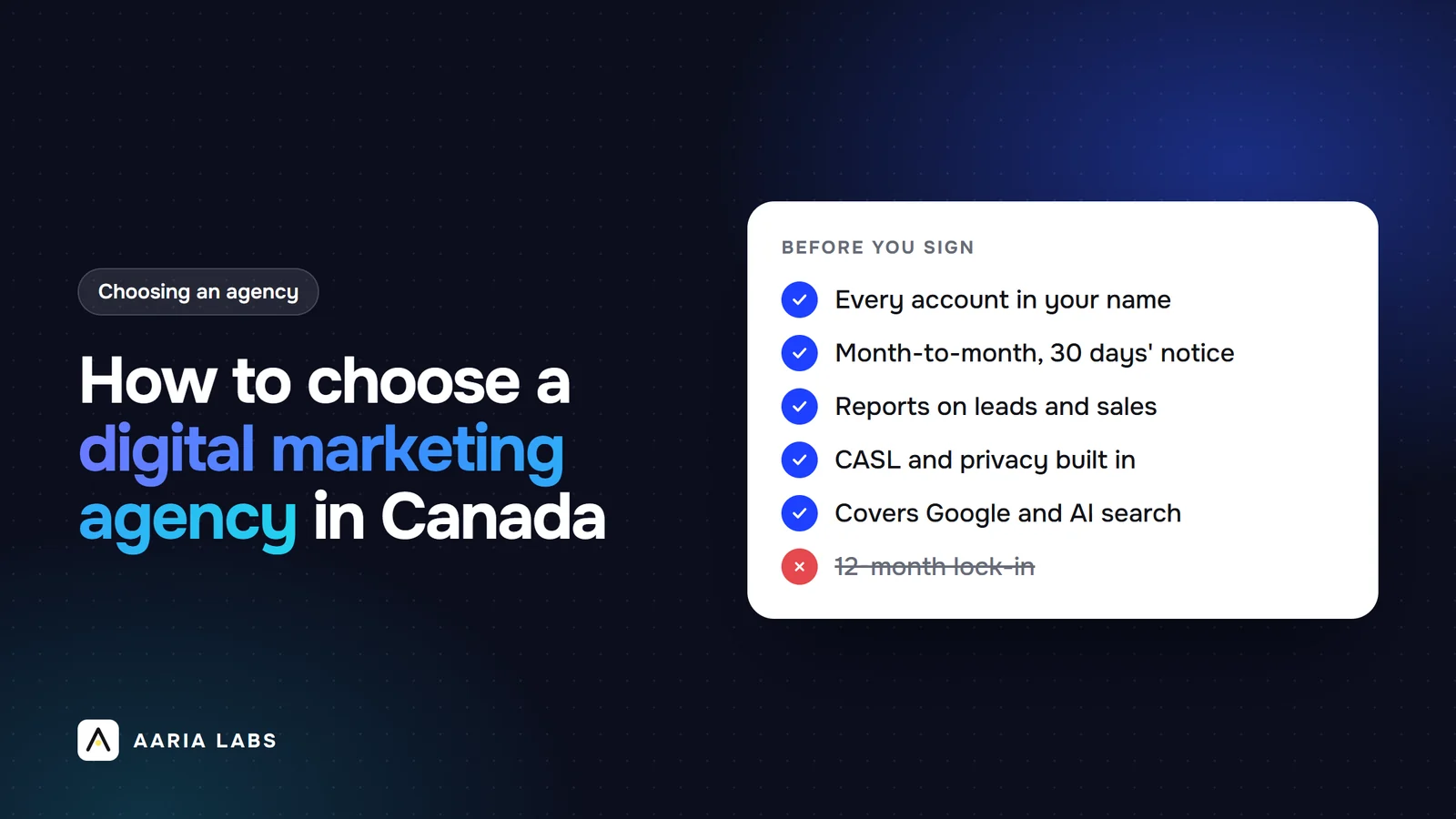
The terms are simple: a free 30-minute first call, a fixed written quote, month-to-month service, and every account set up in your name. We never guarantee AI placement, because no one outside the AI companies can. See examples on our work page, or start with your website if the pages themselves are the gap.
Next step
If you would like to know how ChatGPT, Gemini and Perplexity describe your business today, book a free 30-minute call and we will talk through your questions and your market.
Frequently asked questions
What is an AEO agency?
An AEO agency helps your business get understood, trusted and named by AI assistants such as ChatGPT, Claude, Gemini and Perplexity, and by Google AI Overviews. The work covers a baseline check of what assistants say today, clear facts on your site, structured data, consistent listings, reviews, answer-first content and monthly tracking.
Is AEO the same as GEO, AI SEO and LLMO?
In practice, yes. AEO (answer engine optimization), GEO (generative engine optimization), AI SEO and LLMO (large language model optimization) all describe making a business easy for AI assistants to recommend. When you compare agencies, ask what they actually do rather than which label they use.
How do I get recommended by ChatGPT?
No one can force a recommendation, but you can improve the odds. State clearly what you do and where, keep your listings and profiles consistent, earn reviews and third-party mentions, appear in credible lists in your category, and publish pages that answer customer questions in their first lines. Allow AI crawlers to read your public pages.
Does AEO replace SEO?
No. AEO builds on SEO. A fast, clear, well-linked site helps with both, and many AEO tasks, such as accurate listings, reviews and question-shaped content, also help ordinary search. The difference is that AEO aims to get you named inside the answer instead of ranked as a link.
Should I block GPTBot, ClaudeBot or PerplexityBot?
It depends on your goals. If you want assistants to cite and recommend you, blocking their crawlers works against you, because they cannot cite what they cannot read. If you have paid or member-only content, you can block specific crawlers for those sections and leave public service pages open. Check each company's current documentation first.
How long does AEO take to work?
Fixes to your site and listings can be picked up quickly by assistants that search the web live, but results vary and answers change from run to run. A sensible expectation is to see direction within about three months by tracking the same questions monthly, without any fixed date or guaranteed outcome.
Can an agency guarantee I will appear in AI answers?
No. No agency controls what ChatGPT, Gemini or any other assistant says, and the companies do not publish their exact methods. Aaria Labs never guarantees AI placement. We improve the signals you can control and check monthly how the main assistants describe your business.
Do Canadian businesses need French content for AEO?
If you serve Quebec or francophone customers, yes. Assistants answer in the language of the question, so a French question needs French source material. Publish properly written French pages, mark the language correctly, and keep your Canadian directory listings and city details consistent.